Alprazolam vs. Clonazepam: Which Benzodiazepine is Right for Your Anxiety?
A side-by-side comparison of two of the most commonly prescribed anti-anxiety medications, including onset, duration, side effects, and key safety considerations.
Understanding Your Anxiety Treatment Options
Introduction: Understanding Your Anxiety Treatment Options
Anxiety disorders affect millions of people worldwide, causing persistent worry, fear, and physical symptoms that can interfere with daily life. When non-medication approaches like therapy and lifestyle changes aren’t enough, healthcare providers often turn to medications to help manage symptoms. Two of the most commonly prescribed medications for anxiety are alprazolam and clonazepam, both belonging to the benzodiazepine class of drugs. However, despite belonging to the same class, these two medications differ in several important ways.
This comprehensive guide will compare alprazolam vs clonazepam across key categories, helping you understand the differences and work with your healthcare provider to make an informed decision. For more information on prescription medications available online, visit our website.
What Are Benzodiazepines and How Do They Work?
Benzodiazepines act through the enhancement of gamma-aminobutyric acid (GABA), which is a major inhibitory neurotransmitter in the brain. By increasing GABA’s effects, these medications reduce neural transmission throughout the central nervous system, producing calming, sedative, and muscle-relaxant effects.
Both alprazolam and clonazepam work this way, but they differ in their potency, onset of action, duration of effect, and approved uses.
- Both are classified as Schedule IV controlled substances, indicating some potential for abuse
- Both carry a Pregnancy Category D rating (positive evidence of fetal risk)
- Both require gradual tapering when discontinuing to avoid withdrawal symptoms
- Both can interact with alcohol and other CNS depressants, leading to dangerous side effects
Head-to-Head Comparison: Alprazolam vs Clonazepam
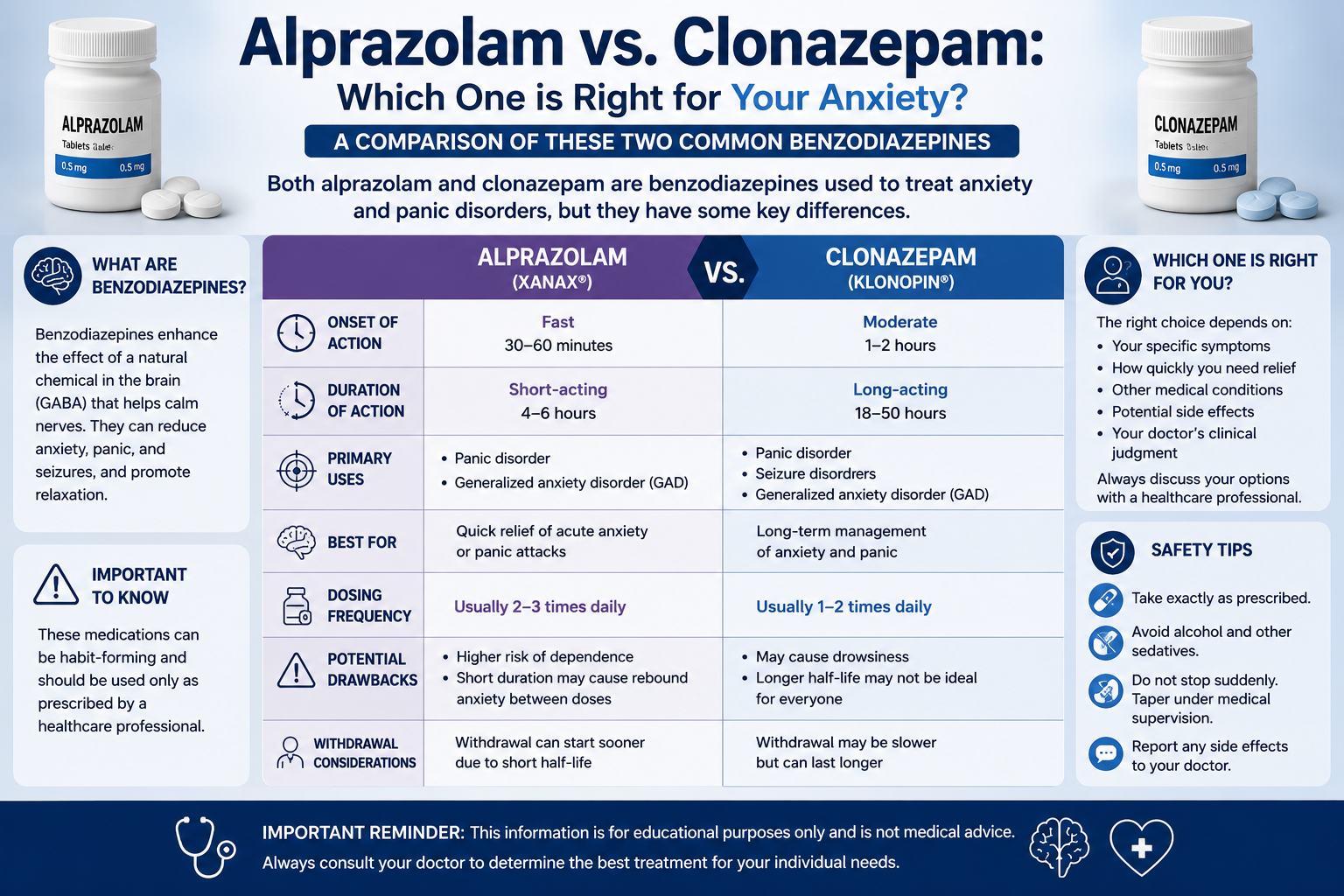
| Feature | Alprazolam (Xanax) | Clonazepam (Klonopin) |
|---|---|---|
| Brand Names | Xanax, Xanax XR, Alprazolam Intensol | Klonopin |
| FDA Approval Date | October 16, 1981 | June 4, 1975 |
| Primary Uses | Generalized Anxiety Disorder (GAD), Panic Disorder | Panic Disorder, Seizure Disorders, Anxiety |
| Onset of Action | 1-2 hours | 1-2 hours |
| Time to Peak Effect | 1-2 hours | 1-4 hours |
| Elimination Half-Life | Approximately 11-20 hours | Approximately 30-40 hours |
| Duration of Action | 3-6 hours | 6-12 hours |
| Common Side Effects | Drowsiness, dizziness, low blood pressure | Drowsiness, dizziness, loss of coordination, increased salivation |
Detailed Comparison: Alprazolam vs Clonazepam
1. FDA-Approved Uses
Understanding when each medication is typically prescribed can help clarify which might be better for your specific condition.
🔵 Alprazolam (Xanax)
FDA-approved for:
- Generalized Anxiety Disorder (GAD): Short-term relief of anxiety symptoms
- Panic Disorder: With or without agoraphobia
Research shows alprazolam is significantly superior to placebo and at least equally effective as tricyclic antidepressants for anxiety symptom relief. Its rapid onset of action, often within the first week of treatment, makes it particularly useful for acute symptom management.
🟠 Clonazepam (Klonopin)
FDA-approved for:
- Seizure Disorders: Including Lennox-Gastaut syndrome, akinetic seizures, and myoclonic seizures
- Panic Disorder: With or without agoraphobia
- Anxiety: May be used for short-term anxiety relief or as a sedative
For panic disorder, both medications have demonstrated efficacy, but studies suggest that the addition of clonazepam to an SSRI at the start of treatment can lead to a more rapid response.
2. Onset of Action and Duration
🔵 Alprazolam (Xanax)
Alprazolam has a fast onset of action, typically beginning to work within 1 to 2 hours. Peak plasma concentrations are reached at 1 to 2 hours after oral administration. The immediate-release formulation is clinically effective for 3 to 6 hours.
🟠 Clonazepam (Klonopin)
Clonazepam typically begins to work within 20 minutes to 1 hour, with peak effects reached between 1 to 4 hours after taking it. Its effects last for 6 to 12 hours.
3. Half-Life and Duration in the Body
The half-life of a drug is the time it takes for the concentration in the body to reduce by half, which influences how long the drug stays in the system and the risk of withdrawal symptoms.
🔵 Alprazolam (Xanax)
- Elimination half-life: Approximately 11-16 hours (range 9-20 hours)
- Time to steady state: 2-3 days
🟠 Clonazepam (Klonopin)
- Elimination half-life: Approximately 30-40 hours
- Duration in body: About 1-2 days
4. Side Effect Profiles
Both medications share many common side effects due to their similar mechanism of action, but there are some differences to consider.
🔵 Alprazolam (Xanax)
- Drowsiness
- Dizziness
- Dry mouth
- Fatigue
- Impaired memory
- Irritability
- Changes in libido
- Low blood pressure and dizziness upon standing
- Sedative effects may be more pronounced
- Short half-life can lead to rebound anxiety between doses
🟠 Clonazepam (Klonopin)
- Drowsiness and sedation
- Dizziness
- Loss of coordination
- Fatigue
- Memory impairment
- Irritability and agitation
- Increased salivation (especially in children)
- Loss of coordination is more common
- Worsening of seizures (rare, but possible in epilepsy patients)
5. Addiction and Dependence Risk
Both medications carry a risk of dependence and are classified as Schedule IV substances. However, the risk may differ:
🔵 Alprazolam (Xanax)
The shorter half-life of alprazolam means that withdrawal symptoms can occur more quickly between doses and when discontinuing the medication. Common withdrawal symptoms include anxiety, agitation, tremors, and seizures. An exhaustive review of the literature showed that withdrawal and rebound symptoms are common at discontinuation, which is why alprazolam discontinuation must be carefully tapered.
🟠 Clonazepam (Klonopin)
Clonazepam’s longer half-life means that withdrawal symptoms may appear more gradually and be less intense for many patients. The risk of dependence increases with treatment duration beyond 2-4 weeks. Withdrawal symptoms can include confusion, seizures, depression, nervousness, sweating, and diarrhea.
6. Drug Interactions
🔵 Alprazolam (Xanax)
- 542 drugs known to interact, including 54 major interactions
- Grapefruit juice interaction can lead to potentially dangerous side effects
- Significant interaction with opioid medications
🟠 Clonazepam (Klonopin)
- 552 drugs known to interact, including 30 major interactions
- Alcohol interaction can increase nervous system side effects such as dizziness, drowsiness, and difficulty concentrating
7. Pregnancy Category and Contraindications
Both medications are Pregnancy Category D, indicating positive evidence of fetal risk. Use during pregnancy should only be considered if the benefits outweigh the risks.
Choosing the Right Option: Alprazolam vs Clonazepam
✅ When Alprazolam Might Be Preferred
- Rapid symptom relief is needed: Alprazolam’s fast onset can provide quick relief from acute anxiety or panic attacks.
- Short-term treatment: For limited-duration anxiety (2-4 weeks), the risk of dependence is lower.
- Flexible dosing: The multiple formulations (immediate-release, extended-release, disintegrating tablets) provide dosing options.
- Better for acute situational anxiety: When anxiety is triggered by specific situations (e.g., flying, public speaking).
✅ When Clonazepam Might Be Preferred
- Chronic anxiety requiring consistent control: The longer half-life provides more stable symptom control with less frequent dosing.
- Co-occurring seizure disorders: Clonazepam is specifically approved for seizure management.
- Concerns about interdose anxiety: The longer duration reduces the risk of anxiety returning between doses.
- Adherence concerns: Less frequent dosing (1-2 times daily) may improve compliance.
- When used as an adjunct to SSRIs: Studies show clonazepam can provide rapid initial response when starting SSRI therapy for panic disorder.
Important Safety Considerations
Boxed Warnings
Both medications carry FDA boxed warnings:
- Risks from concomitant use with opioids: Can result in profound sedation, respiratory depression, coma, and death.
- Abuse, misuse, and addiction: Both medications have potential for abuse, which can lead to overdose and death.
- Dependence and withdrawal: Abrupt discontinuation can cause life-threatening withdrawal reactions, including seizures.
General Precautions
- Never discontinue suddenly: Always work with your healthcare provider to taper the dose gradually.
- Avoid alcohol: Alcohol interacts dangerously with both medications.
- Be cautious with driving: Both can impair cognitive and motor function.
- Inform your doctor about all medications: Interactions with other drugs can be serious.
- Use for the shortest duration possible: Treatment beyond 2-4 weeks increases the risk of dependence.
Conclusion
The choice between alprazolam and clonazepam depends on individual factors, including the specific anxiety condition, the urgency of symptom relief needed, the desired dosing frequency, and the patient’s history with substance use. While both are effective benzodiazepines, their differences in half-life, duration of action, and specific indications make each better suited to different clinical situations.
For acute relief of anxiety or panic with rapid onset, alprazolam may be the better choice. For those needing more consistent, long-lasting symptom control, especially with fewer daily doses, clonazepam may be preferred. For panic disorder with seizures, clonazepam’s dual indication is particularly valuable.
Frequently Asked Questions
🔗 Explore More Resources
Visit Canadian Pharmacy Shop for more information on:
📚 External Resources
For authoritative information on anxiety disorders and treatment options, visit: